Our Vision for 2050
By 2050, Washington’s transportation system is sustainably funded, seamlessly integrated, and built on strong partnerships across all jurisdictions. It supports economic growth while meeting the urgent demands of climate and resiliency—promoting innovation and improving public health and safety to enhance the quality of life for all Washingtonians, now and for generations to come.

Public transit in Spokane
Preface
The Washington Transportation Plan (WTP) Vision 2050 is a policy plan for Washington state designed to provide guidance which can be operationalized and implemented by various transportation agencies, jurisdictions, and transportation service providers across the state. The Transportation Commission facilitated a planning dialogue, engaging the public and transportation providers to develop a long-range plan that supports the advancement of shared statewide priorities.
Today’s Plan Creates Our Tomorrow
Supporting Quality of Life
Transportation is not just infrastructure. It is a public service that directly shapes our quality of life. WTP Vision 2050 is designed to guide efforts that improve the everyday lives of people across the state. A safe, accessible, and resilient transportation system enables more than just mobility, it supports vibrant communities, economic opportunity, and environmental stewardship.
Be Intentional
With rapid population growth, aging infrastructure, and increasing demands on public resources, it is more important than ever that Washington has a clear and unified transportation strategy. Through extensive listening sessions and ongoing partnerships, Vision 2050 serves as the statewide roadmap, identifying shared strategies to collaboratively address climate and resilience challenges and foster innovation in support of improved efficiencies, increased safety, and enhanced mobility. By keeping WTP Vision 2050 up to date through changing times, we are able to align efforts and maintain a strategic path forward.
Working Together Today & Everyday
Turning vision into action demands active and ongoing coordination across sectors, levels of government, and communities. WTP Vision 2050 is designed to guide the efforts of transportation agencies and service providers to align their policies, investments, and priorities. To implement this plan we must break down silos and foster stronger partnerships that lead to integrated solutions. Whether through regional corridor planning, smart infrastructure technologies, or new funding collaborations, the tools are in our hands.
The Future Starts Today!
The urgency in this moment cannot be overstated. Washington is at a turning point, facing challenges that will only intensify with time. Decisions made today about where we invest, how we build, and who we serve will shape the trajectory of our communities for decades. WTP Vision 2050 is not just a long-term vision. It is a call to action. Achieving our goals will require taking the long-view, sustained legislative leadership, and clear policy alignment. Our future mobility, economic vitality, and community wellbeing depend on the steps we take now.
Building the Future We Want
Washington state’s transportation system is continually evolving as investments are made and projects are delivered at all levels of government. But how do we ensure we are collectively moving towards shared goals? We coordinate, communicate, collaborate, and plan together. The Washington Transportation Plan (WTP) serves as the blueprint, establishing a policy framework and shared vision that supports the transportation priorities in state law. So, what are we building for?
By 2050, we can expect roughly 2 million new residents, the equivalent of adding two more Seattle’s to Washington state.
Though much of the growth will be centered on the Interstate 5 corridor, communities across the state will feel the impact. By 2044, it is estimated we will need over a million new housing units, and 400,000 of these will need to be affordable to lower-income households.
To support this growth and development, we must have a safe, connected, and resilient transportation system and use the following long-term vision as our north star.
Washington's Complex Problems Require Big Ideas
WTP Vision 2050 unifies us and charts a collective path forward ensuring we stay on course toward a transportation system that works for our today and tomorrow. This plan sets forth a roadmap to achieve this vision, addressing pressing challenges and working to create a future that is safer, more connected, resilient, and prosperous.
Four cross-cutting solutions emerged through the WTP development that can help different agencies support the implementation of the goals and strategies included in this plan:

Investments in renewable energy sources and advancing clean, sustainable energy must grow across all jurisdictions to achieve current mandates. It will take partnerships with private sector industry to meet our needs, like building alternative fuel infrastructure to support the diversified needs of the traveling public. Fleets must be incentivized to adopt and deploy zero emission vehicles. Transit systems, whether composed of ferries, buses, or trains, must also be powered by renewable energy to achieve our statewide goals. WTP Vision 2050 builds on recent statewide efforts, such as the State Energy Strategy and Climate Resiliency Strategy, which lay out concrete steps for reducing greenhouse gas emissions in the transportation sector.
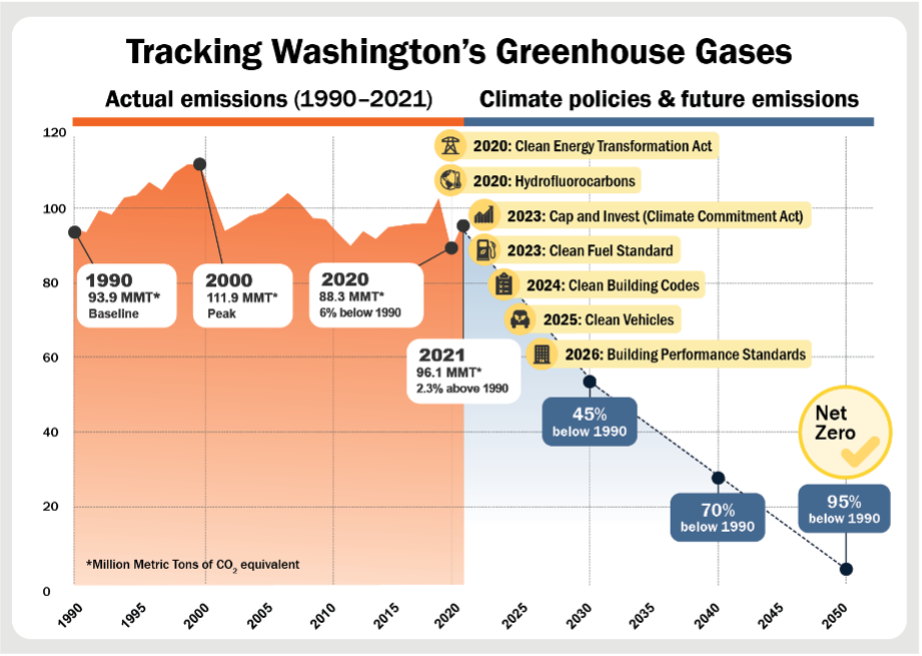
The transportation sector accounts for nearly 40% of Washington state’s greenhouse gas emissions. Through collective action, we must reduce emissions by 95% by 2050,2 and this plan builds on the strong foundation of work the state has undertaken to meet this goal. Prioritizing projects with wide-reaching benefits, like reducing emissions and restoring natural ecosystems, not only improves public health but also strengthens the state’s defenses against climate threats, such as floods, landslides, and wildfires. A renewed focus on maintaining and upgrading our existing system with the integration of resilience planning and new technology ensures that Washington state is better prepared for emergencies and advancing toward a more environmentally and economically sustainable future.
By working together to reduce emissions, advance technology, and expand access to sustainable mobility, we can collectively shape a future that meets the needs of all Washingtonians and delivers on our climate and equity commitments.
It is a powerful tool to achieve meaningful outcomes. Innovations in data, automation, and transportation technologies hold immense potential for increasing safety, reducing emissions, and enhancing mobility. To fully realize these benefits, collaboration between the public and private sectors is essential for making key investments in infrastructure to enable and support the advancement of tech tools.
To meet current law targets of reducing vehicle miles traveled by 50% by 2050, we will need transit systems that are centered on providing more flexible, on-demand service that works more to meet riders where they are and where they need to go. Technology can help deliver services to meet real-time rider demands, utilizing smaller vehicles that enable flexible and nimble access to riders in all types of locations.
Technology must also support seamless and simple travel on transit between cities across the state, whether in urban, suburban, or rural areas to create an interconnected network that provides efficient and timely travel. With the goal of getting 20% of commuters in Washington state to rely on public transportation by 2050, it will be imperative to enable travelers to connect across modes conveniently and seamlessly. This will increase usage, reduce congestion, and support the availability of affordable, efficient and sustainable mobility options.
These partnerships are not only creating jobs and attracting investment, but they’re also demonstrating how strategic collaboration can align transportation infrastructure with long-term economic goals. In areas like the West Plains, located just west of Spokane, public and private entities are working together to unlock the region’s full potential.
One notable example is the collaborative effort between the State of Washington, Spokane County, the City of Spokane, and private companies such as Amazon, Selkirk Pharma, and Spokane International Airport. These partnerships have supported the development of key transportation infrastructure, such as the Geiger Boulevard interchange and improvements to U.S. Highway 2, which have significantly enhanced access to industrial and logistics facilities in the area. These upgrades not only improve freight mobility but also enable employers to more efficiently connect with national and global markets. The aerospace industry, long a cornerstone of Washington’s economy, is also benefiting from this strategic focus.
Competitive grant programs that prioritize multi-jurisdictional partnerships and co-funded corridor plans are essential.
These programs can incentivize innovation by aligning transportation infrastructure with land use goals, such as housing and transit incentives that reduce parking requirements or allow for greater density in areas served by high-capacity transit. Shared data platforms and interagency performance targets will help track progress and ensure accountability across all levels of government, turning collaboration from a concept into a measurable reality and leading us to a financially sustainable system that ensures funding allocations match our shared investment priorities.